

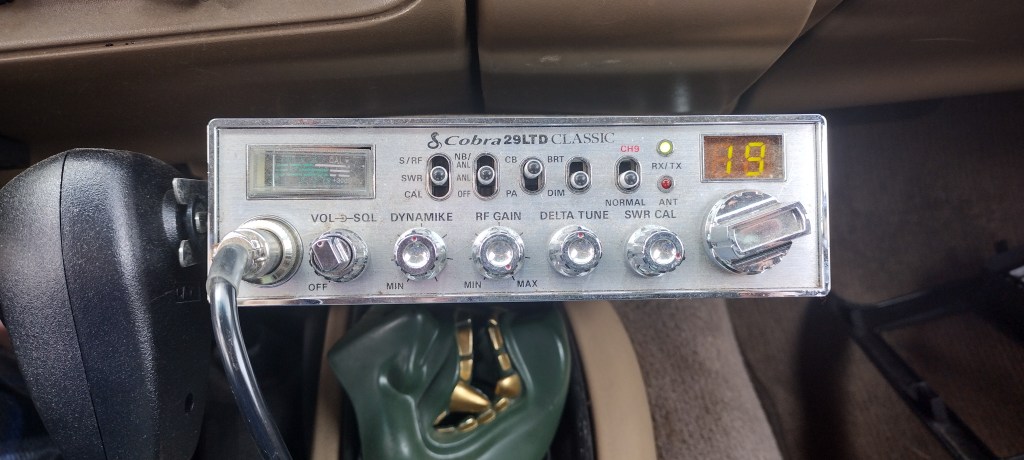
For the first time in my life, I do not have a CB in my vehicle. As far back as I can remember, my parents have always had a CB radio in their vehicles. And that carried over when I moved out of their house and bought my first vehicle. The first thing I did with that vehicle was install a CB radio, and every vehicle I have owned since has followed suit. That is until now, October 2023.
This is my opinion, initial impression, and review of the QYT KT 7900D Quad Band Radio.
Out with the Old
As stated I have had CBs in my vehicles for as long as I can remember. While they’ve typically been Cobra brand radios, I have had a few other brands as well and with few exceptions, they’ve been full size radios which take up a lot of real estate inside the vehicle.

It’s unfortunate that their use is on the decline. I’ve noticed considerably less traffic as of the time of writing this as compared to 10 or even 20 years ago.
In with the New
So after following this guide to get my GMRS license and help my brother get his, it was time to decide on a radio to get. I knew I wanted a GMRS radio but being in the prepper mindset, I also wanted it capable of doing more as well. After looking at the seemingly endless list of what radios are available and in my budget, I settled on the KT-7900d radio.

I knew it was going to be smaller than the CB it was replacing but I didn’t expect it to be as tiny as it was. However, its small size worked out to my advantage giving me an unexpected place to mount it.


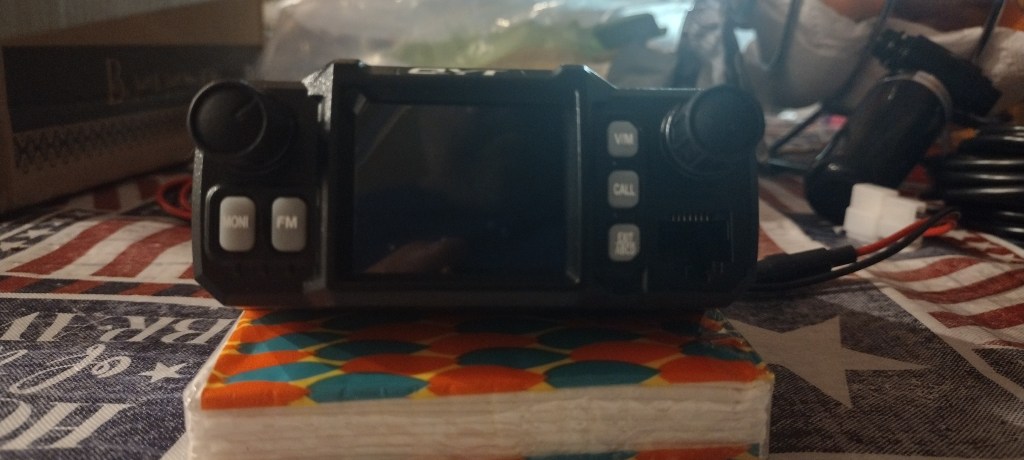
Inside the box along with the radio was the PTT mic, the mounting bracket, mic bracket, all the screws needed, 12v DC cigarette plug cable, and the programming cable. It was because of the included programming cable that I chose the particular Amazon listing I did.
The Install
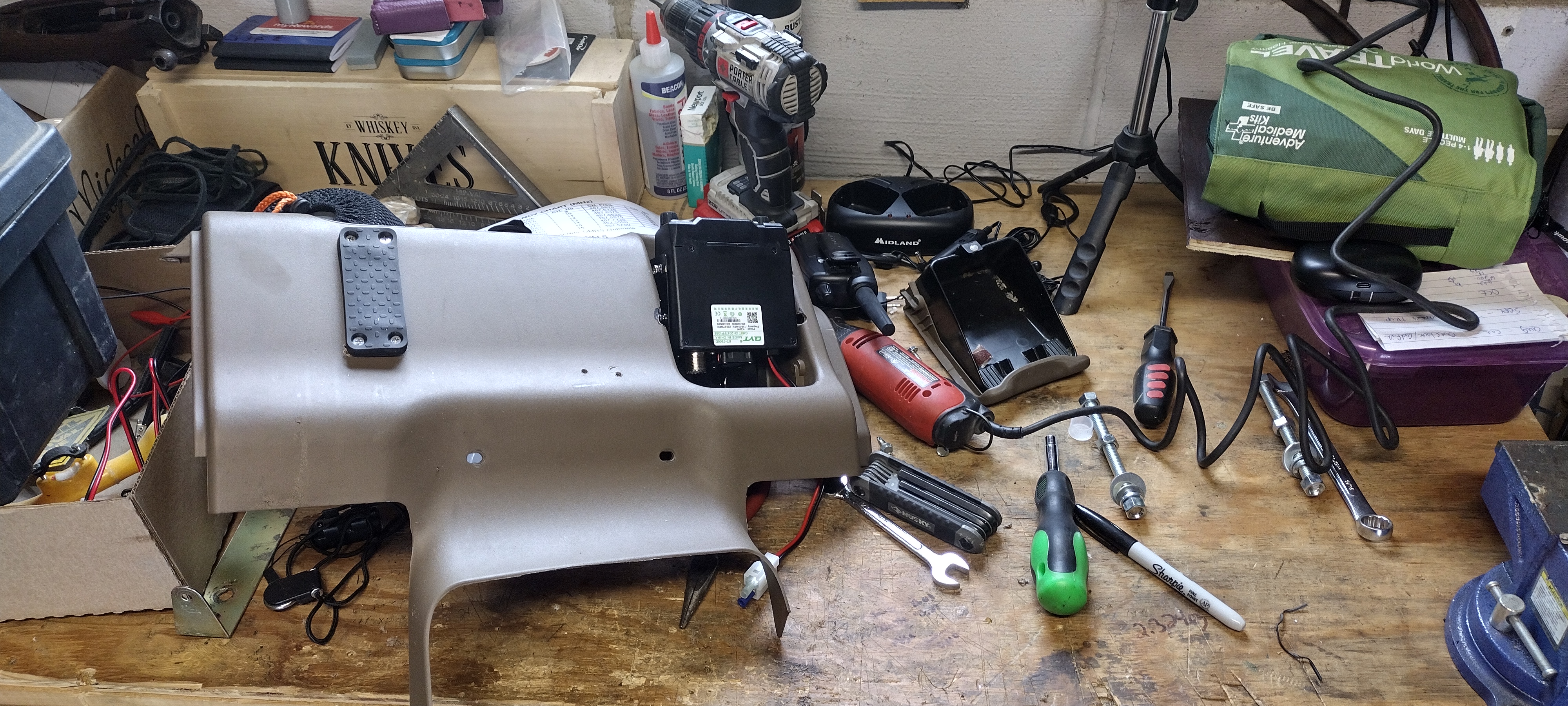
I intended to install the radio just as I had the CB it was replacing. However as I got into it, I accidentally stumbled upon something unexpected. The radio just happened to be the perfect size to fit into the slot on the lower dash panel where Dodge put the ash tray.

For those who may be too young to know, older vehicles had cigarette lighters and ash trays installed because people used to smoke while driving and needed a place to put the ashes from the cigarettes. Now, part of the plastic hinge on mine broke. So it was going to have to be removed regardless.

For the installation to completely work, I still had to do a few modifications. The first was drilling the mounting holes in the exact location for the bracket. Once that was done, I then had to use a sanding wheel on my Dremel to carve out enough of a cavity for the screws to slide through allowing it to fit perfectly.
With the radio mounting location sorted out, it was time to decide where to mount the antenna. After trying a couple of locations on the Durango, I ultimately decided on and went with a hood mounted location.
Mounting in this location puts the A pillar partially blocking the output signal. I was ok with this temporary compromise as I do have plans to incorporate a mount on my custom roof rack and raise it above the roof line. However even with the assumed negatives between mounting location and size of the antenna, my measured first contact to a known fixed repeater was more than I was expecting.
Practical Usage
So where does this leave this radio’s practically? That’s kinda up to you to decide, honestly. I only have my CB and those handheld FRS radios to compare it to. It would be unfair to compare it to the radios I had access to and used while in the military. So for my purposes here, I’ll compare to what I have used that’s openly available to the general public. I will run through my opinion about what I think the pros and cons are for each of these specific 3 radios: Cobra 29LTD Classic CB, Motorola handheld FRS radio, and the QYT KT7900d Quad Band radio.
Cobra 29 LTD Classic CB
Pros
- Longer potential range based off wave length
- No license required
- Easy to install
- Easy to use
Cons
- Size, it’s big so lots of space needed to mount
- Low power (typically limited to 4 watts max)
- Limited average range, typically 1-5 miles at best
- In recent years less people are using it
- Antenna needs to be properly tuned to the radio to avoid potential damage to the radio and to maximize range
- Can get pricey depending on your setup
- Dependent on a 12v power source to operate
- Open channels/frequencies
- Typically no encryption, anybody can hear your conversation
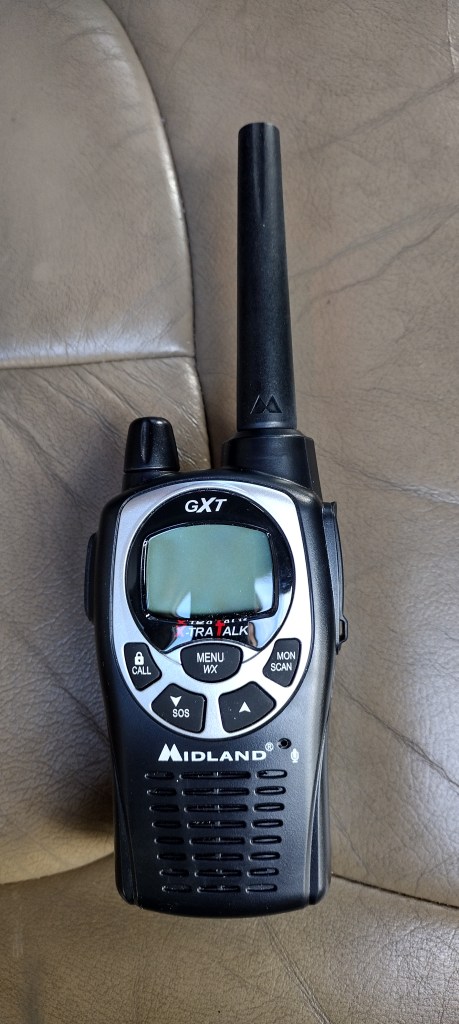
Midland GTX1000VP4 Handheld
Pros
- Available almost everywhere
- Easy to use right out of the box
- No license required
- Extremely portable, small, can easily fit in a pocket or bag
- No tuning required.
- Battery powered, not dependent on an external power source
- Typically comes with rechargeable batteries
- Can run off of regular disposable batteries
Cons
- Battery powered
- Low power (0.5 or 2 watts depending on channel)
- Limited range
- Open channels/frequencies
- Typically no encryption, anybody can hear your conversation
QYT KT 7900d Quad Band Radio
Pros
- Small size
- Can be used as a base or mobile station
- High power (this radio is rated for 25 watts)
- 4 bands of frequencies you can use
- No license required to LISTEN to any given frequency
- Affords access to repeaters to extend range
- Range dependent on power output and antenna used
Cons
- HAM or GMRS license required depending on what band you’re using
- Programming can get technical, so some knowledge required
- Needs to be programmed
- Dependent on a 12v power source to operate
- Due to power output, legally it should not be used on some FRS/GMRS channels
This radio is rated for 25 watts VHF and 20 watts UHF. The measured output on my meter is 26.27w on high power and 8.6w on low power for VHF. I got 15.62w on high power and 8.9w on low power for UHF.
The Antenna
I chose a short antenna to minimize its impact on my view out the windshield as I didn’t know exactly where I was going to end up mounting it. I had a couple of ideas, so I chose my mount to fit those locations. Ultimately I ended up mounting it on the hood. As mentioned previously, I knew there was a compromise with this location.
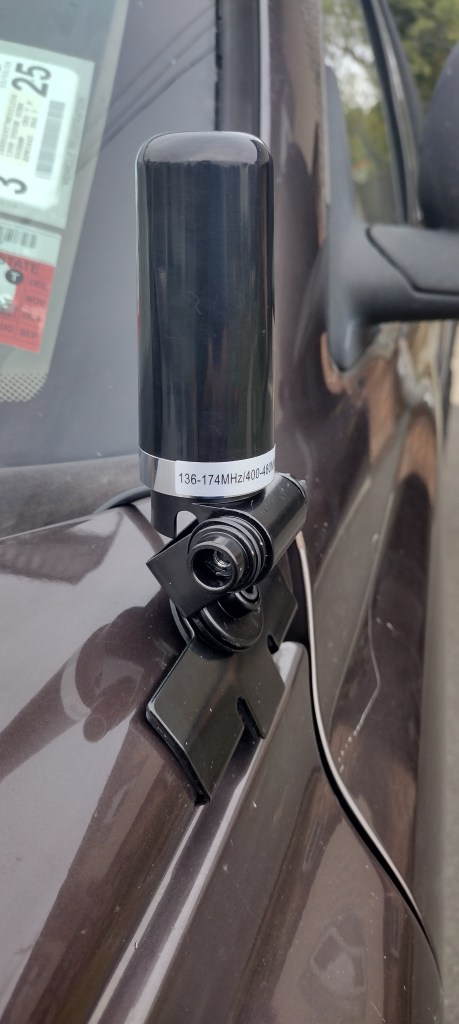
My antenna is a Chinese generic knockoff of the Midland MXTA25 antenna so my expectations were very low. This antenna is made by the Chinese company “Bingfu.” I wasn’t expecting to get any range from it greater than about 5-7 miles at best.

When I finally made my first contact for a radio check on a local repeater, I was impressed to have reached it at 13 miles from where I was at time of contact. This distance was measured using the Google maps measurement tool from my known location to the known fixed location of the repeater I was transmitting to.

It should be noted that this particular antenna is marked as a dual band antenna. However, through my experience and research it is not a dual band antenna as advertised and labeled. It is actually only for the FRS/GMRS band (400-480 MHz).
The following are my SWR readings using my radio, 16.5ft coaxial cable, this exact antenna, and the Surecom SW-102S SWR meter.
- 155.000 MHz: 1:6.48
- 240.000 MHz: 1:6.16
- 370.000 MHz: 1:3.57
- 440.000 MHz: 1:1
- 462.500 MHz: 1:1.4
- 467.500 MHz: 1:1.6
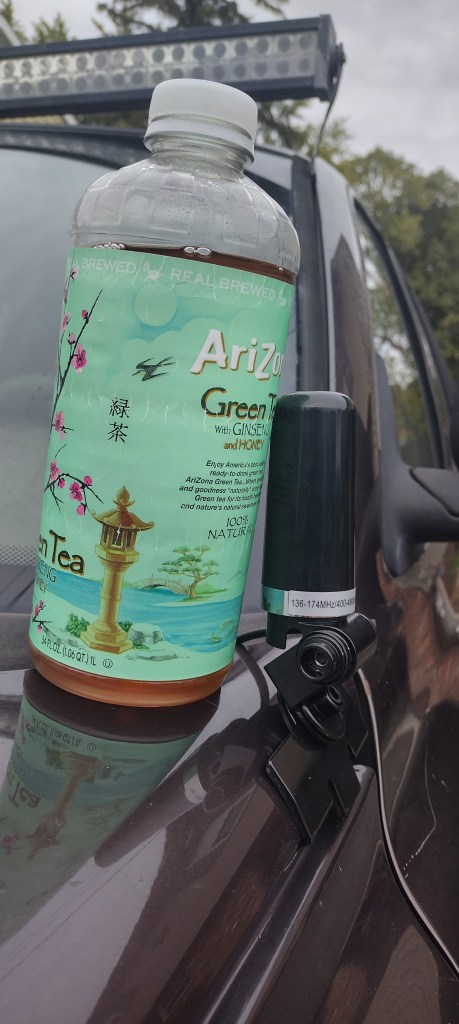
I chose the low profile NMO mount because if I had to drill any holes to mount it, I could at least minimize the hole size and if I ever needed to remove the antenna for an extended amount of time, the mount profile would be almost invisible as well. Not to mention that it also seemed like the most common style of mounts for this application.
Final Thoughts
In comparison to other radios I have used over the years, there’s a bit more of a learning curve to the QYT KT 7900D. However, even with that learning curve, it’s still relatively simple. The biggest learning hurdle for this radio and any like it is in knowing how to program it and what all the programming options are and what they do.
Knowing everything that I know now , I would still buy this radio or buy it again. The power output at 25W is acceptable for my intentions. Being a quad band radio, it has the versatility I am looking for in the event of a potential emergency or societal collapse. With a little research and common sense, programming the radio is pretty simple and straightforward.
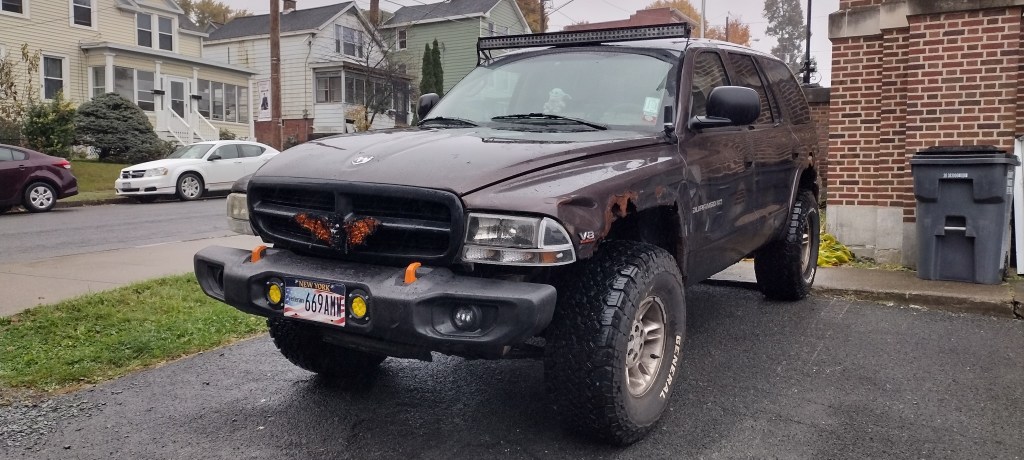
While I am happy with the antenna I chose, I will be getting a whip style antenna to maximize range as well as make sure it is multi band capable so that I can maximize the potential usage of the radio.
With all that said, I am impressed with the power output, programability, range of this radio and antenna combo for its size and being Chinese made. There are some features/aspects of the programming side that I still need to learn and understand. Beyond that I expect to get plenty of life out of the limited use I am predicting for myself. I hope to find a club or group that’s local to get involved with in order to find guidance and expand my knowledge.
I hope this helps you decide if this radio may be right for you and your application.
Links
- FCC License Guide
- KT-7900d Quad Band Radio
- UHF/VHF Shorty Antenna with vehicle mount
- Surecom SW-102s Power/SWR Meter
- XRDS-RF 50W Dummy Load
- PL-259 12in UHF Jumper Cable
- Power Converter (AC 120v to DC 12v)
- Chirp Programming Software
- QTY Programming Software
Remember, If I can do it, You can do it too!!!

 The Wandering Leatherneck
1 Comment